I came across this recently and given that you get both sides of the story (well at least almost) its not a bad way of considering the two big options for iPhone development.
Dom

I came across this recently and given that you get both sides of the story (well at least almost) its not a bad way of considering the two big options for iPhone development.
Dom
Geoff Lamarche is author of the great introductory book (Begnning iPhone development) for the iphone developer – here is the blog for the man: http://iphonedevelopment.blogspot.com/
Dom

Which way to the battle? – The Introduction
This tutorial is a short introduction to iPhone development. Like most of my tutorials it’s based on a game.
This is the second in a series of tutorials. The first tutorial was a TDD tutorial in C# 4.0.
This version of the tutorial is similar in functionality to the C# version with obvious changes to the UI as needed. I am not using a TDD approach, mainly because I am not really up to TDD on the iPhone yet.
By completing this tutorial you will:
CannonAttack iPhone is a simple game where a player enters an angle and velocity of a cannonball to hit a target at a given distance. The game uses a basic formula for calculating the trajectory of the cannonball and the player keeps taking turns at shooting at the target until it has been hit
Where are the cannonballs – What you need:
I built this with the following tools:
Whilst this is a pretty basic introduction to iPhone development, it assumes a very basic knowledge of iPhone development and while it doesn’t spell out every single step, you should have more than enough detail to complete it.
The battleplan – The CannonAttack Requirements/Specs:
The following is a combination of Requirements and Specifications that will give us some guide in terms of the application we are trying to build:
distance = velocity * Math.Cos(angleInRadians) * time;
height = (velocity * Math.Sin(angleInRadians) * time) – (GRAVITY * Math.Pow(time, 2)) / 2;
Building the Cannon – Creating the Cannon UI
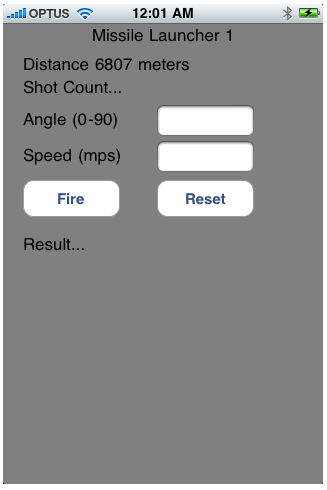
#import <UIKit/UIKit.h>
@interface CannonLauncher1ViewController : UIViewController {
IBOutlet UILabel *descriptionLabel;
IBOutlet UILabel *resultLabel;
IBOutlet UITextField *speedTextField;
IBOutlet UITextField *angleTextField;
IBOutlet UILabel *shotCountLabel;
int targetDistance;
int shotCount;
}
//Properties
@property (nonatomic,retain) UILabel *descriptionLabel;
@property (nonatomic,retain) UILabel *resultLabel;
@property (nonatomic,retain) UITextField *speedTextField;
@property (nonatomic,retain) UITextField *angleTextField;
@property (nonatomic,retain) UILabel *shotCountLabel;
//Actions
-(IBAction)fireButton:(id)sender;
-(IBAction)resetButton:(id)sender;
-(IBAction)backgroundClick:(id)sender;
//Methods
-(void)hideNumberKeyboard;
-(void)resetTextBoxes;
@end
So now add the following code to the .m file
#import "CannonLauncher1ViewController.h"
#import "Cannon.h"
@implementation CannonLauncher1ViewController
@synthesize descriptionLabel;
@synthesize resultLabel;
@synthesize speedTextField;
@synthesize angleTextField;
@synthesize shotCountLabel;
- (void)viewDidLoad {
[super viewDidLoad];
[self resetTextBoxes];
}
//Button handler for the fire button
-(IBAction) fireButton:(id) sender
{
NSInteger velocity = [[speedTextField text]intValue];
NSInteger angle = [[angleTextField text]intValue];
Cannon *cannon = [[Cannon alloc]init];
cannon.targetDistance = targetDistance;
[cannon Shoot:angle Speed:velocity];
shotCount ++;
resultLabel.text = cannon.message;
shotCountLabel.text =
[NSString stringWithFormat: @"Shot Count %d", shotCount];
[self hideNumberKeyboard];
[cannon release];
}
//Button handler for the reset button
-(IBAction) resetButton:(id) sender
{
[self resetTextBoxes];
}
//Button Handler for the main backgtound button
-(IBAction)backgroundClick:(id)sender
{
[self hideNumberKeyboard];
}
//Hides the number keyboard
-(void)hideNumberKeyboard
{
[speedTextField resignFirstResponder];
[angleTextField resignFirstResponder];
}
//Reset the distance and set it as rge text of the description label
-(void)resetTextBoxes
{
targetDistance = rand() %10000;
NSString *distanceText = [[NSString alloc] initWithFormat: @"Distance %d meters (50m",targetDistance];
descriptionLabel.text = distanceText;
speedTextField.text = @"";
angleTextField.text = @"";
shotCount = 0;
[distanceText release];
}
//Built in Method I didn't change this
- (void)didReceiveMemoryWarning {
// Releases the view if it doesn't have a superview.
[super didReceiveMemoryWarning];
}
//Built in Method to clean up any objects
- (void)dealloc {
[descriptionLabel release];
[resultLabel release];
[speedTextField release];
[angleTextField release];
[shotCountLabel release];
[super dealloc];
}
@end
OK so all we have to do now is implement the cannon class.
Now edit the cannon.h file and replace the code with this header code:
//
// Cannon.h
// CannonLauncher1
//
// Created by Dom Millar on 16/06/10.
// Copyright 2010 __MyCompanyName__. All rights reserved.
#import <Foundation/Foundation.h>
@interface Cannon : NSObject {
@private int targetDistance;
NSString *message;
}
@property (readwrite,assign)int targetDistance;
@property (nonatomic,retain) NSString *message
-(IBAction) Shoot: (int) angle Speed: (int) speed;
@end
Now all we have to do is add the code for cannon.m
//
// Cannon.m
// CannonLauncher1
//
// Created by Dom Millar on 16/06/10.
// Copyright 2010 __MyCompanyName__. All rights reserved.
//
#import "Cannon.h"
@implementation Cannon
@synthesize targetDistance;
@synthesize message;
-(IBAction) Shoot: (NSInteger) angle Speed: (NSInteger) velocity
{
//set up the local variables for the shoot method
float time = 0;
float height = 0;
float distance = 0;
float gravity = 9.80665;
float variation = 50;
float pi = 3.1415926536;
//Keep calculating height and distance untill height < 0
while(height >= 0)
{
float angleInRadians = ( pi / 180 ) * angle;
distance = velocity * cos(angleInRadians) * time;
height = (velocity * sin(angleInRadians)) - (gravity * pow(time,2));
time++;
}
//Complete calculation
if ((targetDistance >= distance-variation) && (targetDistance <= distance+variation))
{
//Display the hit
message = @"Hit";
}
else
{
//Display the Miss
NSString *description = [NSString stringWithFormat:@"Missed target landed at %f meters" , distance];
message = description;
//[description release];
}
}
@end
Now make sure everything builds. Go back interface builder and you need to do setup the following outlets and actions:
This shows you all the hooks we need:
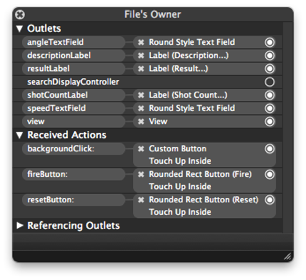
OK now You should be ready to run, go back to XCode and run the app and you should be able to play the game like:
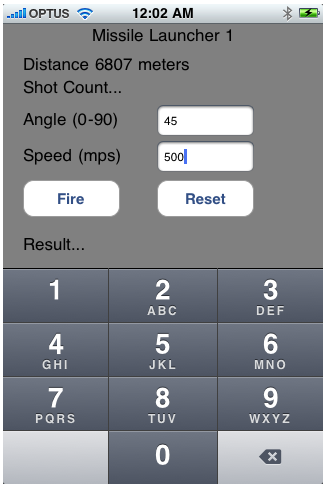
You can see the Keyboard is visible here – once we click on a button or the main screen the keyboard will disappear:
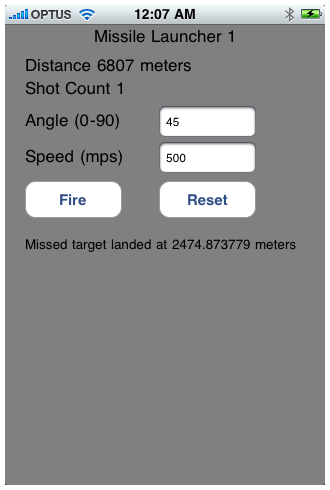
Victory Condition – In summary
So that’s it – our latest version of the Cannon Attack game is complete. There are lots of changes you can make to make the game more interesting so play around with the project as much as you like.
Happy Coding – Dom.
Introduction:
This is a short guide to resolving the issue of the expired certificate using XCode with the iPhone SDK – its probably relevant for setting up your certificate from scratch as well. I am not totally convinced this is the best way of fixing the expired certificates for iPhone Development, but it worked for me so.
The Environment:
The development environment is a follows:
The Problem:
You’ll may get a variety of messages when the certificate expires and they will include:
a valid signing identity matching this profile could not be found in your keychain
or :
code sign error: the identiy matching this profile could not be found in your keychain
or
You currently do not have a valid certificate
Getting a new certificate:
Dom
Not a free resource but given that its almost 3 weeks of training I think $800 is pretty cheap:
Dom

Code (Please Note was built with XCODE 3.0.1)
#import “iPhone_TorchViewController.h”
Summary
Ok so this was an extremely simple applIcation and no test driven development (Curse you Dom) but was achieved in just over an hour and considering this is my first iPhone app – I am pretty happy. In terms of the process, it was all fairly basic but as we consider this series of Projects you’ll see things get more complex.
Dom
 Doms Code